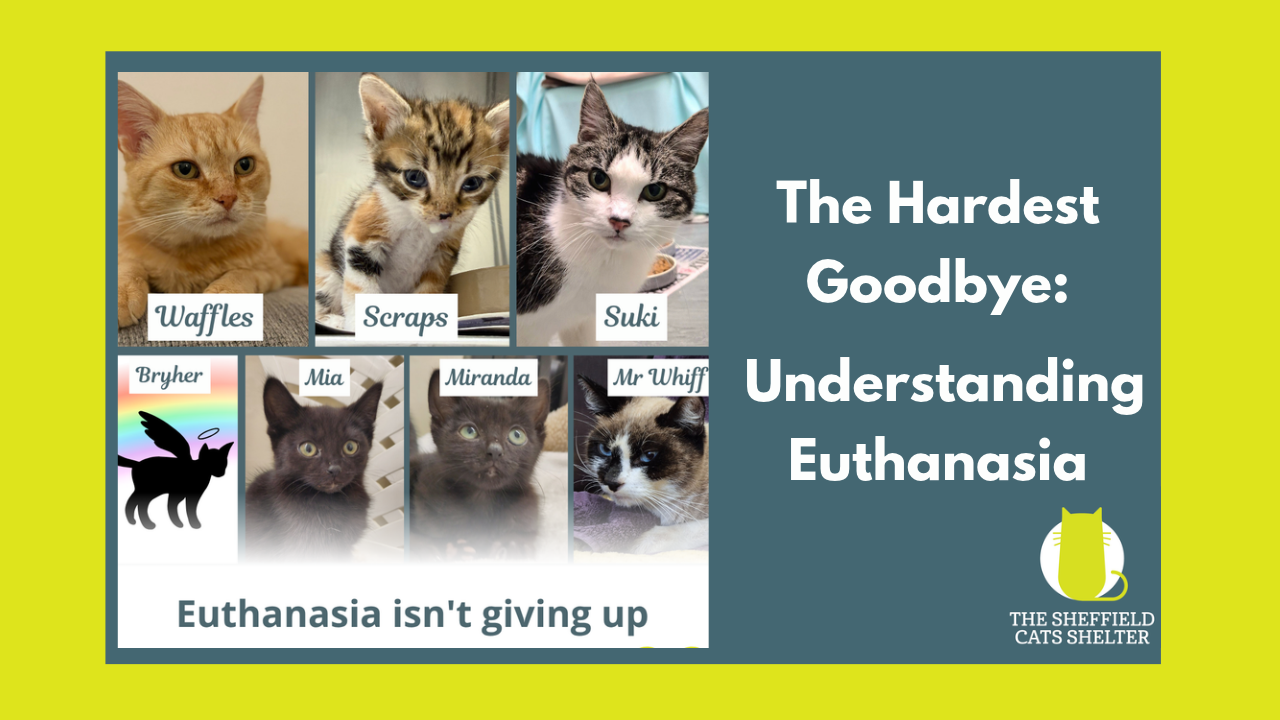
There are some conversations that are incredibly difficult to have.
For pet owners, one of the hardest is the conversation about euthanasia.
Even the word can feel frightening. People can experience sadness, guilt, uncertainty and sometimes even shame when faced with the decision to say goodbye to a beloved pet.
But euthanasia is an important part of veterinary care, and we believe it is something we should be able to talk about openly and compassionately.
Because sometimes, when every other option has been explored, letting a cat go is the kindest thing we can do for them.
What does euthanasia mean?
The word euthanasia comes from Greek and means “good death.”
In veterinary care, euthanasia is a peaceful way of ending an animal’s life when they are suffering, and their quality of life can no longer be maintained.
It isn’t giving up.
It isn’t failing them.
And it isn’t something anyone should feel ashamed of.
Sometimes, it is the final act of care we can give.
Euthanasia is always our last option
Here at The Sheffield Cats Shelter, euthanasia is always the very last thing we consider.
When a cat is struggling, in pain or becoming unwell, our first priority is finding out what is wrong and seeing what we can do to help.
Our staff and veterinary team work together to understand each individual cat’s situation. We consider their medical needs, their behaviour, their comfort and, most importantly, their quality of life.
We explore every possible route that could help.
Sometimes that might mean treatment, medication, further investigation, specialist advice, changes to their environment or simply giving them more time and support.
But there is another important part of that decision too: whether further treatment is actually in the cat’s best interests.
Just because there is another test, treatment or procedure available does not always mean it is the right thing to put a cat through.
We will always ask:
- Will this help the cat?
- Will it give them a realistic chance of a good quality of life?
- And will the treatment itself cause more stress, fear or discomfort than the benefit it may provide?
We will try everything we reasonably can as long as it remains in the cat’s best interests.
We never want to prolong suffering simply because there is technically something else we could try.
How do we make such a difficult decision?
There is no single person at The Sheffield Cats Shelter who simply decides that a cat should be euthanised.
These decisions involve discussion.
Our cat team talks together. The people who know and care for that cat every day can share what they have seen: how the cat is behaving, whether they are eating, whether they seem comfortable, whether they are still enjoying the things they normally would, and whether their quality of life is changing.
We also work closely with our vets, who can advise us on the cat’s medical condition, treatment options and likely prognosis.
In many cases, we are constantly asking questions and reassessing the situation.
Our decision-making process looks something like this:
A cat is unwell, in pain or struggling.
⬇️
We investigate what is happening and seek veterinary advice.
⬇️
Are there treatment or management options available?
⬇️
If there are, will they realistically improve the cat’s quality of life?
⬇️
Can those options be provided without causing unacceptable stress, suffering or discomfort to the cat?
⬇️
If the answer is yes, we continue exploring those options.
⬇️
If there are no realistic options left, or treatment is no longer helping the cat live comfortably, we have further discussions with our team and vets.
⬇️
We ask the most important question of all: what is in this cat’s best interests?
The answer will be different for every individual cat. There is no simple formula, no magic number and no single person making the choice.
The cat’s welfare is always at the centre of every conversation.
When there are no more good options
Sadly, there are times when we reach a point where we have tried everything we reasonably can, but a cat is still suffering.
They may be in pain that cannot be adequately controlled. They may be struggling to eat, move or carry out normal daily activities. They may have a serious or progressive illness with no realistic prospect of a good quality of life ahead.
These are some of the hardest conversations our team has to have. There is no single checklist that can tell us exactly when the time is right. Every cat is an individual, and every situation is different.
That is why so much discussion goes into these decisions.
We talk with our vets. We talk as a team. We consider what the cat is experiencing now and what their future is likely to look like.
And ultimately, we ask ourselves the most important question: What is the kindest decision for this cat?
Better a day too soon than a minute too late
There is a saying that it is better to make the decision a day too soon than a minute too late.
Of course, every situation is different, and there is no perfect moment or simple answer.
But when a cat is suffering, and there is no longer a realistic prospect of a good quality of life, we have to put their needs before our own.
Because sometimes our hearts are saying, “I don’t want to lose you,” while the kindest thing for the cat is to say, “I won’t make you suffer any longer.”
That is an incredibly painful decision. But it can also be an act of immense love.
What happens when a pet is euthanised?
For many people, part of the fear comes from simply not knowing what will happen.
If you are facing this decision with your own pet, your veterinary team can talk you through exactly what to expect and answer any questions you have.
The process is designed to be peaceful and to prevent further suffering.
Depending on the individual animal and situation, a vet may first give medication to help them become relaxed or sleepy. The euthanasia medication is then given by the veterinary professional, and the pet loses consciousness before passing away.
Your vet will let you know when your pet’s heart has stopped, and they have crossed the rainbow bridge.
It is also important to know that there can sometimes be physical reflexes or changes after death. These can be upsetting if you are not expecting them, so you can always ask your vet beforehand to explain anything you may see.
There is no shame in asking questions.
There is no shame in being frightened.
And there is no shame in saying that you do not know if you are ready.
Your veterinary team is there to support you as well as your pet.
“How do I know if I am making the right decision?”
This may be one of the most difficult questions a pet owner can ever ask.
Unfortunately, there is rarely a moment when someone feels completely ready to say goodbye.
Many people who have had to make this decision carry guilt afterwards. They question whether they waited too long, whether they acted too soon or whether there was something else they could have done.
But if you are worried about your pet’s quality of life, talk to your vet.
Ask questions. Be honest about what you are seeing at home. Tell them if your cat is no longer eating, moving comfortably, grooming, enjoying things they once loved or having more bad days than good.
And if a veterinary professional has assessed your pet, talked through the options with you and believes euthanasia is the kindest choice, remember this:
You are not choosing to hurt your pet. You are making a decision to prevent further suffering.
A vet will not simply suggest euthanasia for a healthy cat with a good quality of life without carefully considering their welfare and the available options.
If euthanasia has been recommended because your pet is suffering or their quality of life can no longer be maintained, choosing that peaceful goodbye is not murder.
It is care.
It is one of the hardest decisions we can make because we often have to carry the pain of losing them so that they do not have to carry the pain of suffering any longer.
Saying goodbye at the Shelter
When a cat reaches the end of their journey with us, we make sure they are not alone.
Even if they have only been with us for a short time, they have become part of the Shelter family.
Our staff care for them. We get to know their personalities. We worry about them. We celebrate their good days.
So when we have to say goodbye, we feel that loss too.
We make sure they have a peaceful and special send-off, with a member of our team staying with them, giving them comfort, love and reassurance.
They don’t leave this world alone.
Let’s talk about it
We know that euthanasia is a difficult subject.
But difficult doesn’t mean we shouldn’t talk about it.
If you have ever had to make this decision for your pet, you may have wondered whether you did the right thing. You may have felt guilty. You may have questioned whether you waited too long, or whether you said goodbye too soon.
Those feelings are incredibly common.
But choosing euthanasia when a pet is suffering isn’t something to be ashamed of.
It can be the final promise we make to them:
“I love you enough to put your needs before my own.”
We want to help normalise conversations about euthanasia, because no one should feel ashamed for facing one of the hardest decisions that can come with loving an animal.
Talking about the hardest parts of pet ownership can help us better understand the choices available to us and, ultimately, make decisions based on what our animals need rather than what we wish we could hold onto.
Sometimes we can save them. Sometimes we can treat them. Sometimes we can give them more time. And sometimes, after every option has been explored, the kindest thing we can give them is a peaceful goodbye.
That is not giving up. That is care.
🌈 Their time may be short. Their lives still matter. And they deserve to be loved until the very end.🌈
If you’re struggling with pet loss
If reading this has brought up feelings of grief, guilt or sadness, please know that you don’t have to go through it alone. 💚
Pet loss can be incredibly painful, whether you’ve lost a lifelong companion, had to make the decision to say goodbye, or are grieving a cat who was only part of your life for a short time.

Blue Cross Pet Loss Support has been supporting people through pet loss for more than 30 years. Their Pet Loss Support team provides free and confidential support through telephone, email and webchat, with trained volunteers available every day of the year.
Call: 0800 096 6606
Available every day, 8.30 am–8.30 pm
Email: plsmail@bluecross.org.uk
The team aims to respond within 48 hours.
Whether your pet has died, you’ve had to make the heartbreaking decision to let them go, or you’re struggling with the feelings that come afterwards, there is someone you can talk to.
There is no right way to grieve, and there is no timeline for missing someone you loved.
Please be kind to yourself. 🌈🐾